Small Business Marketing Operations: The Four Parts and Where to Start
Oct 22, 2026 · 5 min read
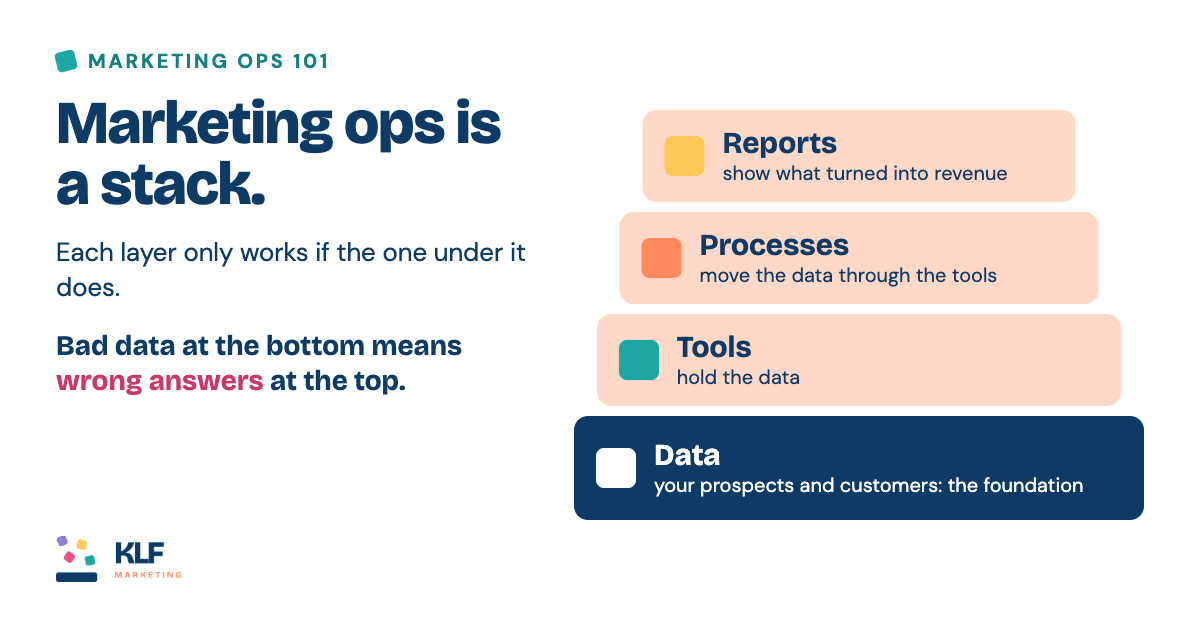
Short answer: Small business marketing operations is the behind-the-scenes system that makes your marketing measurable: your customer data, the tools that hold it, the processes that move it, and the reports that show what turned into revenue. It has four parts. Start with the problem you keep working around. For most, that's the customer list.
Big companies have whole teams for "Marketing Operations". In fact, I've led enough of them to confidently say I've probably seen your data before.
A small business in Rochester, Syracuse, Buffalo or the Finger Lakes? Usually has one person doing it part-time, without the title. Often the owner. Often at 11pm.
This guide is for that person.
What is marketing operations for a small business?
Marketing operations is everything that has to happen so your marketing works and your small business can tell whether it did.
At a large company it sits where data, tools, processes and measurement overlap. At a small business, it's the stuff that hangs over your head at night.
If marketing is the billboard, marketing operations is the person waiting for the paper to be delivered, driving out to the location, gluing it up, then scanning the QR code to make sure the web page they also built actually works.
At a small business size, it usually shows up as one of these:
- The same customer appears three times in your email list
- Contact form inquiries sit in someone's inbox instead of your customer database
- You're paying for more than one tool that sends email
- Every report starts with an hour of copying and pasting, using a formula only you know
These are shockingly common problems, and they are fixable.
What are the four parts of marketing operations?
Marketing operations has four parts: data, tools, process and measurement. They work in that order, and each one inherits whatever the one before it hands over.
- Bad data → the tool becomes useless
- Good data → good tool → bad process → measurement is inconsistent
| Part | The questions it answers | What it looks like when done well in a small business |
|---|---|---|
| Data |
Is our customer and prospect information accurate and complete? Do we know where it lives? |
One customer list with duplicates removed, email permissions recorded, and groups that help you send relevant messages |
| Tools | Does each tool earn its place? Where is there function overlap? Do they work well together? |
Your website, customer database and email or booking software share information without constant copying and pasting |
| Process | What happens when a form is filled out, and who handles it? Does it happen the same way every time? |
A website inquiry gets recorded, assigned to someone and followed up on. Yes, even when the owner is busy. |
| Measurement | Can we connect what we spend on marketing to business results? | A monthly report showing which activities brought in inquiries, bookings, sales and repeat customers |
While it can be tempting to start with measurement, don't. Accurate measurement is the GOAL of marketing operations, not the starting point.
The SBA's marketing and sales guide suggests good marketing only starts once you compare spend vs. the actual revenue it brings in. This is great advice, with a catch: a dashboard is only as honest as the information underneath it.
The answers you are eager to get out of your reporting are only accurate once good habits start upstream: record where each inquiry came from, keep customer information organized, and give follow-up a clear owner.
Where do small businesses start with Marketing Operations?
Start with the problem you keep working around. You don’t have to fix all four parts at once. Fix one recurring problem, make the fix repeatable, then move to the next.
Not sure which problem that is? Find the one below that sounds most like your week.
| If this keeps happening | Start with |
|---|---|
| You're not sure who's on your email list, so you don't send | Data |
| Two or three tools all hold customer emails | Tools |
| Website inquiries get answered late, or not at all | Process |
| You can't say which marketing brought in customers | Measurement |
If more than one sounds familiar, start with the one highest on the list. Each part inherits whatever the one above it hands over.
PRO-TIP: If you only do one thing this week, write down every place a customer's email address lives. The register system, the booking app, the website form, the spreadsheet, the notebook by the phone. Ten minutes. That list is your map for all four parts.
Where I land
The goal of marketing operations isn't a fancier dashboard. It's being able to run, measure and improve your marketing without personally holding every piece together.
You've been told marketing is too difficult and that you're unqualified to do it. Neither is true. You were just never handed the plumbing diagram.
If you'd like help deciding what comes first, a Game Plan gives you a written 90-day plan built around your business, your priorities and the time you actually have. It's 2.5 hours one-on-one with me, $500 one time, and there's no retainer pitch.
Difficult questions, answered.
Is marketing operations the same as marketing?
No. Marketing is the message: the offer, the words, the photo in the email.
Marketing operations is the setup that gets that message to the right people and tells you whether it worked: a clean customer list, the tools that hold it, a follow-up routine and a simple monthly report.
At a small business the same person usually does both.
Does a small business need a CRM?
A CRM, meaning a customer database that tracks every contact and conversation, helps once inquiries come from more than one place.
Many small businesses already have one inside their register, booking or email software.
Before buying a new one, check what you already pay for and pick one home for your customer list.
How much time does marketing operations take for a small business?
After the first cleanup, about an hour a month is enough for most owner-run businesses.
Use that hour to remove duplicates and unsubscribes, check that website inquiries were answered, and note where new customers came from.
The first cleanup takes longer, depending on how many lists you have and how old they are.



Got a difficult question of your own?
Leave a comment. Your email stays private.